Back to Blog


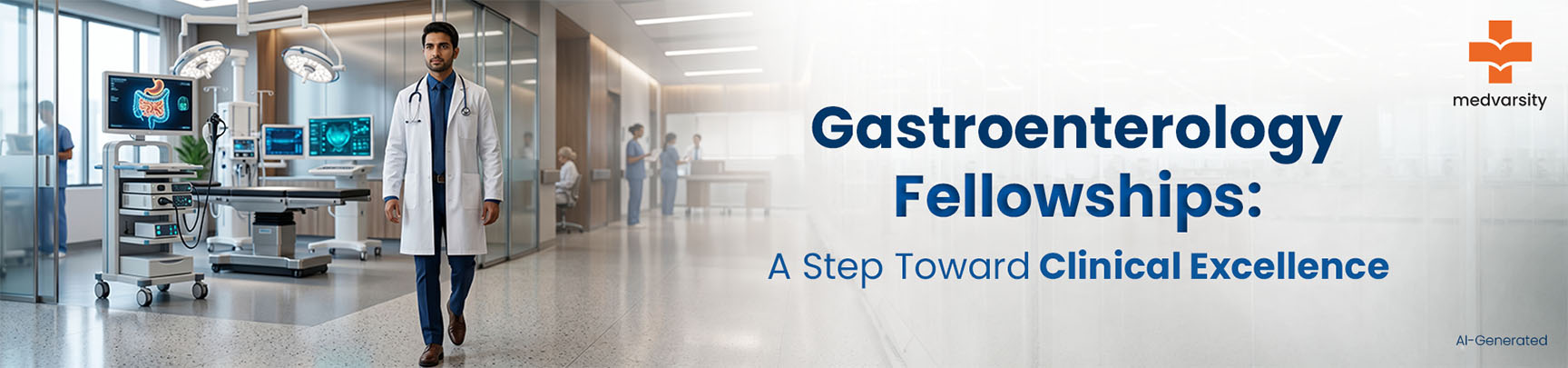
Gastroenterology Fellowships: A Step Toward Clinical Excellence
Susmitha GJune 5, 2026
7 viewsMost doctors can treat common GI complaints, but can they handle what comes next?
Let us assume a 47-year-old man walking into your OPD one fine afternoon. He has had this dull, nagging discomfort in his upper abdomen for nearly three months now. He has tried antacids, nothing worked. And just over the last two weeks, his wife noticed his eyes looked a little yellow. His ultrasound came back inconclusive. His family is sitting outside, visibly worried. You have fifteen minutes before your next patient.
For a general physician, this moment can feel like standing at the edge of something you were not quite trained for. For a gastroenterologist, it is a familiar clinical picture with a clear next step.
That gap between uncertainty and confidence is not about how hard someone studied in medical college. It is not about intelligence or dedication. It comes down to one thing: targeted, specialty-focused training. And that is precisely what a fellowship in gastroenterology is designed to build.
If you are an MBBS or MD graduate sitting on the fence about whether this investment of time and effort is worth it, here is what the landscape actually looks like. Gastroenterology specialists are in short supply across India. The earning potential far exceeds general practice. And perhaps more importantly, the clinical depth this specialty offers the satisfaction of actually solving complex cases is something most doctors describe as genuinely transformative.
Why Gastroenterology Is One of the Most In-Demand Specialties in India Right Now
There is a quiet but serious crisis playing out in GI health across the country. Liver disease is climbing. Colorectal cancers are being diagnosed younger. Inflammatory bowel disease, once considered rare in India, is showing up in outpatient clinics with increasing regularity. Pancreatic disorders, long misunderstood and underdiagnosed, are now filling the waiting rooms of tertiary care hospitals.
Driving all of this are lifestyle shifts, diets heavy in processed food, rising alcohol consumption, and an aging population that brings with it a whole different set of GI vulnerabilities.
Yet for all of this growing clinical need, the number of qualified gastroenterologists in India remains nowhere near sufficient. The demand is real, the gap is wide, and for doctors willing to pursue focused gastroenterology training, the career opportunity is significant.
The traditional route to becoming a gastroenterologist an MD in Internal Medicine followed by a DM in Gastroenterology takes many years and competes for a very limited number of super-specialty seats. For doctors already in practice, or those who did not secure a PG seat in a relevant branch, that pathway is simply out of reach.
A structured gastroenterology fellowship, designed for working doctors, fills that gap in a way the traditional system was never built to.
What Does a Fellowship in Gastroenterology Actually Cover?
This is worth addressing directly, because there is a lot of confusion about what fellowships actually deliver versus what a short online course offers.
A well-built gastrointestinal fellowship is not a series of recorded lectures you click through at midnight. It is a proper clinical education program, one that covers diagnostic reasoning, procedural exposure, and the kind of nuanced decision-making that only comes from studying real cases under real supervision.
The curriculum of a rigorous fellowship in gastroenterology spans the full width of the specialty. You start with GI physiology and move through hepatology: liver disorders, cirrhosis, portal hypertension, the conditions that fill hepatology wards every single day. You cover surgical gastroenterology, including esophageal and pancreatic disease. Congenital GI anomalies, often overlooked in general practice training, get proper attention. And palliative care for patients with chronic GI and liver disease, a deeply human and often undertaught part of the specialty is woven in as well.
The One Skill That Separates Good Doctors from Great Gastroenterologists
Ask any senior gastroenterologist what the fellowship experience truly gave them, and most will say some version of the same thing: it changed how they think.
Clinical reasoning in gastroenterology is rarely straightforward. Patients present with overlapping complaints. Investigations contradict each other. Comorbidities muddy the picture. There is no algorithm that covers every situation.
A fellowship in gastroenterology trains you to work through that complexity to weigh a patient's full history, apply evidence-based clinical decision support, and arrive at a management plan you can defend and stand behind. It teaches the factors that affect clinical decision making in ways that a textbook listing of conditions simply cannot. Patient history, resource availability, co-existing illness, the patient's own priorities, all of it becomes part of how you think, not just what you know.
This is patient-centred decision making in practice. And it is the marker of a clinician who is genuinely ready to lead.
Fellowship in Gastroenterology After MBBS
Plenty of young MBBS graduates ask this question, and it is a fair one. Does pursuing a fellowship in gastroenterology without a postgraduate degree carry real weight?
Honestly, yes, with the right program behind it.
Not every doctor takes the MD route before specialising, and not every MD happens to be in a branch that feeds naturally into gastroenterology. Many of the most capable gastroenterology practitioners in smaller cities and towns built their expertise through structured fellowship pathways combined with consistent clinical exposure.
What matters is the quality of the program. A fellowship with a credible clinical observership component, faculty who are actively practising in the specialty, and accreditation from recognised bodies internationally is not a shortcut. It is a serious training pathway built around the realities of how working doctors actually learn.
Why Endoscopy Training Is Non-Negotiable in Any Gastroenterology Program
You cannot train a gastroenterologist without training them in endoscopy. It is that simple. Upper GI endoscopy, colonoscopy, and the procedural reasoning that goes with them sit at the very heart of GI diagnosis and treatment. Suspected ulcers, early malignancies, colorectal assessment, GI bleeding, the endoscope is central to almost every high-stakes workup in this specialty.
What Successful Training in Gastrointestinal Endoscopy Actually Looks Like
Here is what it does not look like: a few online endoscopy courses and a certificate.
Successful training in gastrointestinal endoscopy requires supervised exposure to real clinical environments. It means watching experienced endoscopists handle a range of presentations, not just textbook cases but the messy, ambiguous ones. It means understanding procedural decision points: when to advance, when to pause, how to manage an unexpected finding, how to counsel a patient after a difficult procedure.
Clinical endoscopist training at its best blends theoretical grounding, understanding image interpretation, procedural sequencing, transducer selection with direct observational experience in a setting where experienced clinicians are walking you through their reasoning in real time. That combination is what builds the instinct that good endoscopy requires.
What to Actually Look for in a Gastroenterology Fellowship in India
The market for online gastroenterology courses has grown considerably, and not all of it is worth your time or money. When you are evaluating a gastroenterology fellowship in India, there are a few things that genuinely cannot be compromised on.
Accreditation carries real weight. A gastroenterology certification backed by bodies like the CPD Standards Office UK or ACCME tells hospitals, colleagues, and patients that your training met an international standard. A gastroenterology diploma course without credible accreditation is, at best, a learning exercise.
Clinical exposure is the difference-maker: The observership component, actual time inside a hospital, watching real cases, being present for clinical decision making in healthcare is what separates a fellowship from a course. If a program does not have this built in as a core requirement, look elsewhere.
Faculty should be practitioners, not just educators: The best gastroenterology programs are taught by doctors who are currently in the field, managing complex cases, dealing with the scenarios you will face. That currency of experience changes the quality of what gets taught.
Depth of curriculum matters: A solid certificate in gastroenterology or gastroenterology diploma course should not just walk you through common presentations. It should take you into the difficult territory of hepatic emergencies, failed endoscopic procedures, complex congenital anomalies and the cases that test whether your training was truly thorough.
Medvarsity's Fellowship in Gastroenterology — What It Offers
For doctors who want a gastroenterology program that takes the specialty seriously, Medvarsity's Fellowship in Gastroenterology is among the most comprehensive options currently available in India.
It is a 12-month blended learning program built for MBBS, MD, MS, and DNB graduates. The curriculum moves through hepatology, surgical gastroenterology, congenital GI anomalies, palliative care, and endoscopy covering the specialty in real depth, not just in breadth.
The standout element is the clinical observership at a leading hospital. This is a structured placement where you work alongside practising gastroenterologists, observe real patient management decisions, and apply everything the online modules taught you in an environment that reflects actual clinical practice. There is no substitute for this kind of exposure when it comes to building genuine clinical confidence.
The online delivery is designed around the realities of a working doctor's schedule. Modules can be accessed at your own pace, from wherever you are, without needing to step away from your current practice.
Gastroenterology is only going to become more central to Indian healthcare over the next decade. The disease burden is growing. The specialist gap is widening. And the doctors who choose to build this expertise now through serious, structured training will be the ones setting the standard of care tomorrow.
Medvarsity's Fellowship in Gastroenterology is doing exactly what this moment in Indian healthcare demands, helping doctors stay clinically sharp, build real specialty depth, and show up for patients who need a lot more than a referral slip.